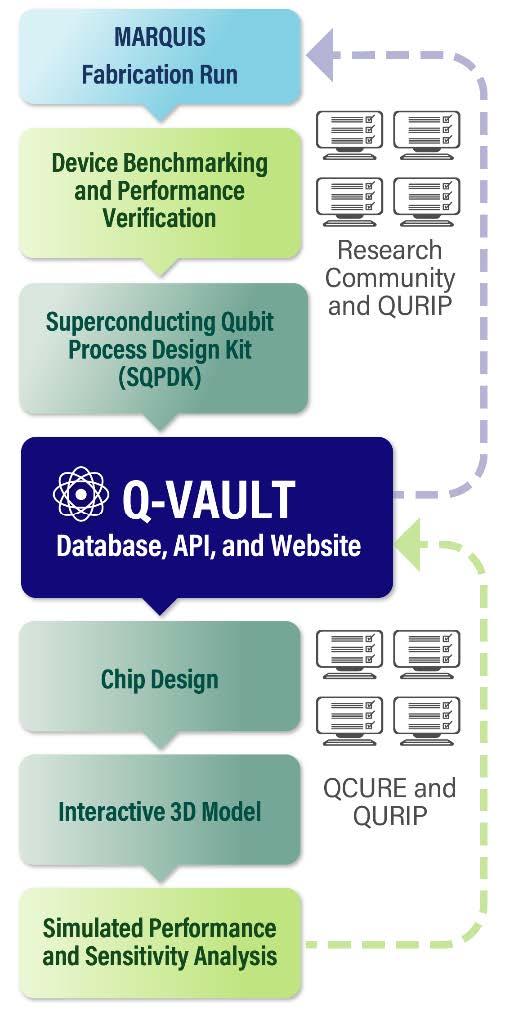
To build a sustainable and adaptable foundation for QIS research, education, and dissemination, MARQUIS will establish a unified, open-access characterization database and application programming interface (API). This centralized infrastructure will support reproducible, multi-institutional research while enabling scalable education, training, and workforce development. Hosted at Dartmouth the Q-VAULT will aggregate fabrication metadata and multimodal characterization data—coherence times, quality factors, noise spectra, quasiparticle dynamics, and broadband TLS defect characterization —collected across MARQUIS experimental platforms.
Currently, there is no comprehensive open-source database that links fabrication metadata with device performance metrics in a standardized and accessible format. Without such shared infrastructure, institutions must independently develop and maintain their own data pipelines, resulting in fragmentation, duplication of effort, and a reduced opportunity for collaboration. The Q-VAULT addresses this critical gap by enabling high-quality data sharing that is essential for innovation in QIS engineering and research. To move beyond proof-of-concept devices and toward scalable quantum systems, researchers need access to shared datasets that allow them to: (1) benchmark materials and device performance across fabrication platforms; (2) optimize fabrication recipes based on empirical trends; (3) correlate material properties with coherence and reliability metrics; and (4) validate emerging design and fabrication strategies. Well-documented, open-source datasets empower these activities by providing the evidence required for data-driven improvement and cross-institutional innovation. The Q-VAULT will thus serve as the cornerstone of infrastructure that supports both discovery science and engineering advancement in QIS. Features of the API will include a public-facing, user-friendly web interface; structured tools and guidance for uploading, querying, and downloading datasets; clear governance and open collaboration policies to ensure equitable use and avoid siloing; and training and documentation for new users to support reproducible data practices.